
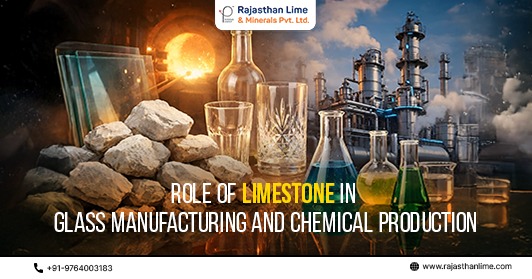
Among all the industries and their processes, limestone is one of the most widely used natural minerals. Among those industries are those that work on glass manufacturing and chemical production. In both of them, limestone is preferably used for thermal processing, purification, and material stabilization. Understanding its entire functioning in the procedure of manufacturing glass or producing several chemicals is important for people to use it appropriately on a large scale.
What is the Role of Limestone in Glass Manufacturing?
Limestone plays an important role from the start to the end of the process of glass manufacturing. Its role ranges from improving the durability to providing chemical resistance to glass. This material acts as a stabilizer in the glass-making process, ensuring that the final product does not dissolve easily in water or degrade over time. The following are some roles of limestone provided by the biggest limestone manufacturers India, explained in detail.
1. Addition to Glass Raw Materials
In the process of glass manufacturing, raw materials that are typically used include silica sand, soda ash, and limestone. Each of them has a specific function. When limestone is added to these raw materials, it:
- Provides calcium oxide when decomposed at high temperatures
- Helps to stabilize the silica structure in molten glass
- Prevents the water solubility of glass products
- Improves overall chemical resistance
2. Improve Durability
Limestone enhances the mechanical strength and resistance of glass. Noting the importance of durability, limestone is used in glass manufacturing to:
- Increase hardness and scratch resistance
- Reduce brittleness of glass in the end of the manufacturing process
- Enhance resistance of the glass to environmental factors
- Improve the lifespan of product
3. Melting Process
The melting stage is energy-intensive, and limestone indirectly supports efficiency. The melting process in glass manufacturing occurs at a temperature of over 1,500°C, where the calcium carbonate component of the material breaks down into calcium oxide and integrates into the glass matrix. It interacts with other raw materials to ensure uniform melting and proper bonding. Here, limestone is used to:
- Facilitate the fusion of silica and soda ash
- Maintain consistent viscosity in molten glass
- Support efficient furnace operation
4. Glass Quality and Transparency
The clarity of glass is critical to be taken care of as it determines the use of the material to fulfill its uses in the form of windows, lenses, and containers. Limestone contributes to this by maintaining the right chemical balance.
- It prevents unwanted chemical reactions during the time of cooling
- It maintains structural uniformity in the product
- It supports optical clarity in glass
What is the Role of Limestone in Chemical Production?
Like many other procedures, the role of limestone is an irreplaceable one in chemical production too. It is used as a raw material, neutralizing agent, and reactant in the chemical industry to form compounds like quicklime or slaked lime. The quality of the product needed also explains the critical focus on why limestone quality matters.
1. Quicklime and Slaked Lime Production
Limestone undergoes calcination, i.e., it is heated at high temperatures to produce quicklime. The many uses of quicklime in the chemical industry further include being hydrated to form slaked lime. Both of them are essential industrial chemicals.
- Quicklime reacts with water to form slaked lime
- Used in construction, water treatment, and chemical synthesis
- Forms the base for many downstream chemical processes
2. Neutralization Reactions
Limestone and its derivatives are commonly used to neutralize acids in industrial processes. This process, as well as limestone’s involvement in it, plays a key role in wastewater management.
- Used in wastewater treatment plants
- Neutralizes acidic industrial effluents
- Helps maintain pH balance in chemical reactions
- Reduces environmental pollution
3. Other Chemical Products
In the production of several important chemicals used in agriculture, sanitation, and industrial manufacturing, limestone is used as a raw material.
- Used in manufacturing calcium carbide
- Plays a role in soda ash production (Solvay process)
- Supports the production of bleaching powder
- Used in fertilizers and soil conditioners
4. Environmental Protection
One of the most important modern uses of limestone is in pollution control and environmental protection.
- It removes sulphur dioxide in flue gas desulphurization
- It is used in air pollution control systems
- It helps to reduce acid rain formation
- It supports sustainable industrial practices
Conclusion
Limestone is not just a regular raw material but a crucial component in both glass manufacturing and chemical production. Its various abilities like stabilizing glass, enabling chemical reactions, supporting environmental protection, and many others, define its huge importance and make it indispensable across industries.
Contact us at Rajasthan Lime, the best hydrated lime manufacturers in India, providing limestone as well as all its products like quicklime, dolomite lime, etc., for industrial use.
FAQs
Q. What is the use of limestone in the glass industry?
Limestone is used in the glass industry to stabilize the glass and increase its hardness, along with chemical durability.
Q. What is the use of limestone in the chemical industry?
In the chemical industry, limestone is needed for the production of quicklime, slaked lime, cement, and many other products.
Q. Why is limestone important to the environment?
Limestone is important to the environment as it helps treat water and wastewater and is used in flue gas desulphurization to remove sulphur dioxide.