
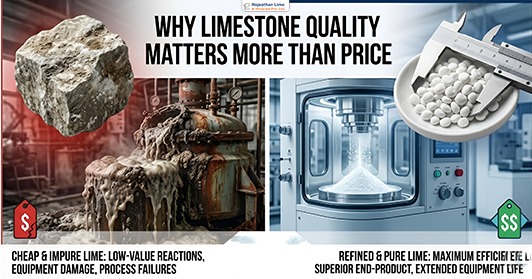
Across several different industries and the applications they play a role in, limestone is one of the most widely used natural resources. The industries it is used in include construction, infrastructure, agriculture, manufacturing of steel, glass, and much more. Across industries like these, many people choose their suppliers and lime manufacturers in India depending more on the price they would have to pay and less on the quality of material they would be getting. However, the quality of limestone, which would determine the performance, durability, and long-term value of the final product, is more important.
Why Should You Focus More on the Quality of Limestone?
When you plan to purchase a huge quantity of limestone and focus solely on cost, there is a great chance that you will overlook essential characteristics that determine how effectively the material performs in practical use. The following are some of the major reasons why quality matters more than price:
- Consistency in chemical composition: Limestone with a higher volume of calcium carbonate typically performs better in cement manufacturing, metallurgy, and environmental applications.
- Improved durability and strength: High-quality limestone tends to have better compressive strength and weather resistance, making it suitable for use in construction.
- Lower processing costs: Pure limestone requires less processing, crushing, or chemical correction during industrial use, which can reduce energy consumption and processing expenses.
- Reduced waste and operational disruptions: Poor-quality limestone may contain impurities that can disrupt industrial processes or increase waste generation.
How Does the Limestone Quality Influence Applications?
Limestone is used in several sectors for a huge variety of applications, all of which need this material, but with some differences in characteristics. Hence, paying attention to the quality and characteristics of the material you are getting along with your use for it must be checked before buying it. The following are some processes of limestone to final product that can be affected without the use of proper quality material:
1. Cement Production
The largest amount of limestone across the world is used in cement production, and poor or inappropriate quality of material being used can heavily affect the chemical balance required during clinker formation. The key quality requirements of limestone during cement production include:
- High volume of calcium carbonate
- Low impurities in the form of magnesium and silica
- Consistent mineral composition across different batches
- Suitable particle size for proper grinding
2. Construction
In construction, limestone is used as aggregate, dimension stone, and base material to build roads and foundations. The important quality characteristics of limestone include:
- Compressive strength
- Resistance to weathering
- Low water absorption
- Uniform density
3. Agriculture and Soil Conditioning
In agriculture, limestone is used to neutralize acidic soil and improve crop productivity, where chemical purity and particle size distribution of the material are important to consider. The higher-quality agricultural limestone provides:
- Better soil pH correction
- Faster reaction with soil acids
- More efficient nutrient absorption by crops
How to Check the Quality of Limestone?
To evaluate the quality of the limestone you will be purchasing or have already done so and whether it justifies its price or not, the best measures to take include laboratory testing, analyzing supplier documentation, and geological assessments.
1. Check Chemical Composition Reports
One of the most reliable indicators of limestone quality is the analysis of its chemical components, which the supplier can provide in the form of laboratory test reports. The key parameters to review in these reports, according to your requirement, include:
- Calcium carbonate (CaCO₃) content
- Magnesium carbonate levels
- Silica or clay impurities
- Trace elements
2. Evaluate Physical and Mechanical Properties
To be used in construction and infrastructure projects, the evaluation of the strength and durability of limestone is critical. Testing for the same helps you determine whether the material is ready to withstand mechanical stress and environmental exposure or not. The common tests to analyze these factors include:
- Compressive strength testing
- Density measurement
- Water absorption analysis
- Abrasion resistance
3. Review Industry Certifications and Standards
To use limestone in any process, you need to ensure that the quality of the material complies with the set industry standards that ensure consistency and quality across different projects. The relevant frameworks set for the use of limestone may include guidelines that need to be mandatorily followed from:
- ASTM International
- National construction or mining authorities
Conclusion
Although cost is a factor that influences your choice of limestone supplier, you should never ignore the quality of the material, as it has a direct impact on the efficiency and long-term project outcomes. While lower prices may seem attractive, the use of poor-quality limestone will make you regret it later due to increased processing costs, reduced product quality, and operational risks.
Contact Rajasthan Lime, the best limestone suppliers Rajasthan, to find the best quality of limestone at an affordable price.
FAQs
Q. What are the industrial applications of limestone?
There are many industrial applications of limestone, some of which include manufacturing soap, detergent, glass, and cement, soil neutralization, wastewater treatment, construction, etc.
Q. What is high grade limestone?
High-grade limestone is a high-purity carbonate rock material characterized by a calcium carbonate (CaCO₃) content of over 97% or a calcium oxide (CaO) content exceeding 54.3%.
Q. Which is the best quality of limestone in India?
The best quality of limestone in India is found in Rajasthan.