
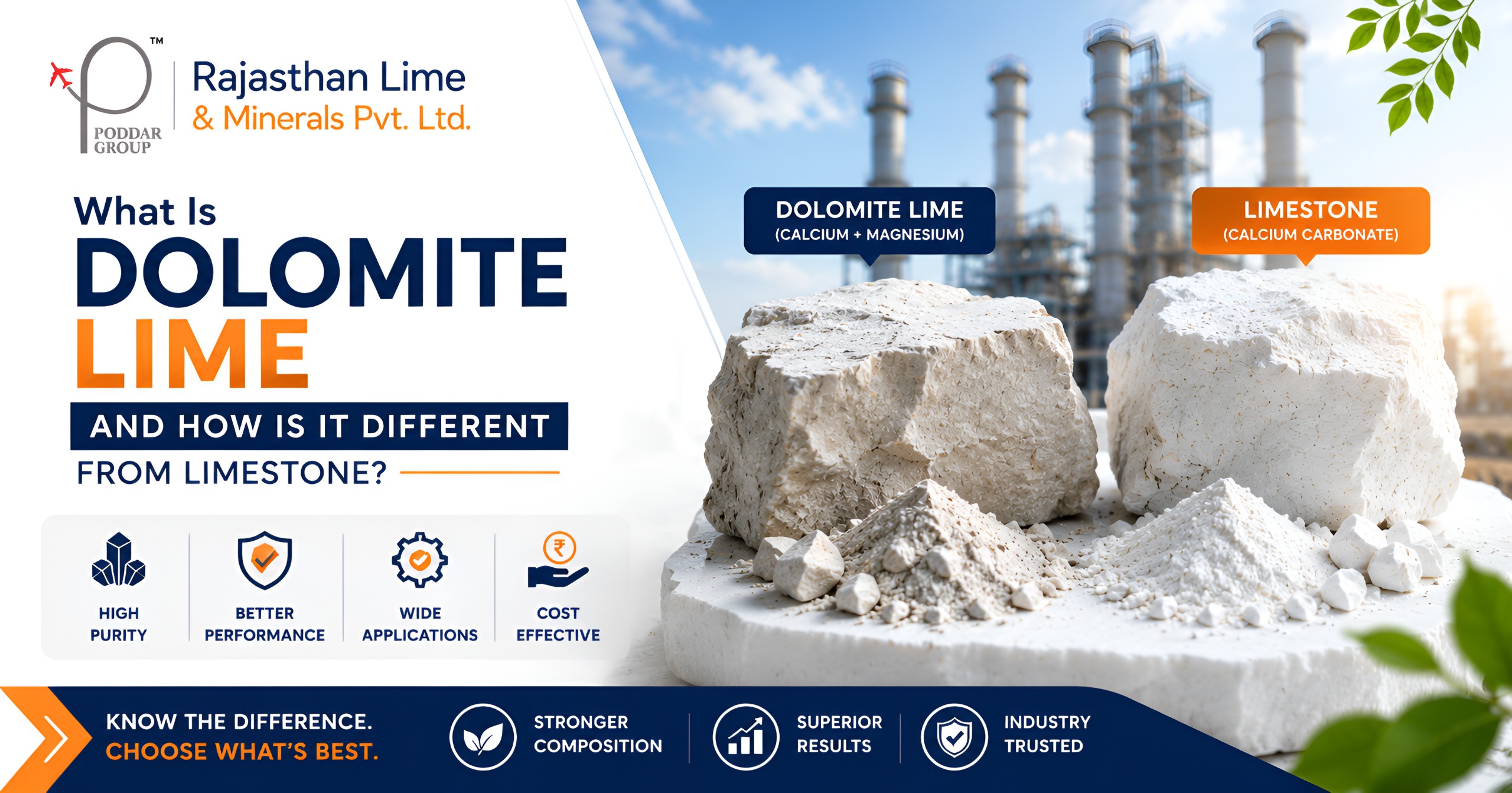
Two of the most widely used materials across different industries for the manufacturing of several materials are dolomite lime and limestone. The many industries they are used in include steel manufacturing, construction, agriculture, glass production, water treatment, etc. Across these industries, users face a common confusion about which one to use and to eliminate this confusion, knowing the difference between dolomite lime and limestone is essential. This includes understanding their mineral composition, chemical properties, and industrial applications, all of which affect the product quality, operational efficiency, and production costs.
What Is Dolomite Lime?
Dolomite lime is a naturally occurring carbonate rock primarily composed of dolomite, containing a huge amount of magnesium along with calcium carbonate. This significant volume of magnesium makes it different in its physical and chemical behavior, making it suitable for several industrial applications that require both calcium and magnesium. Key characteristics of dolomite lime bought from a supplier of dolomite lime products in Jodhpur include:
- Contains both calcium and magnesium carbonates
- Usually white, grey, pink, or light brown in color
- Harder and denser than many limestone varieties
- Offers excellent thermal stability
- Provides magnesium along with calcium
- Available in powder, crushed stone, chips, and calcined forms
What Are the Uses of Dolomite Lime?
Dolomite lime is a valuable material used heavily across many industries. The following are some examples of the industrial uses of dolomite lime.
1. Steel Manufacturing
During steel production, many types of impurities like silica, phosphorus, and sulphur need to be removed. In such a case, dolomite acts as an effective flux while also protecting furnace linings. It is used in:
- Blast furnaces
- Basic Oxygen Furnaces (BOF)
- Electric Arc Furnaces (EAF)
- Refractory brick manufacturing
- Slag conditioning
2. Glass Manufacturing
Glass manufacturers require raw materials with controlled chemical composition to ensure clarity, durability, and strength in the manufactured glass. The types of glass produced by including dolomite lime in the process include:
- Flat glass
- Container glass
- Automotive glass
- Fiberglass
- Specialty industrial glass
3. Construction and Cement Industry
Dolomite lime is widely used as a construction material because of its strength, durability, and weather resistance. Some common applications of top-quality dolomite lime bought from Rajasthani lime manufacturers include:
- Cement manufacturing
- Concrete aggregates
- Road base material
- Asphalt mixtures
- Railway ballast
4. Environmental and Water Treatment Applications
Industries use dolomite lime to help control water chemistry and neutralize acidic conditions, hence making it an important part of environmental and water treatment applications such as:
- Industrial wastewater treatment
- Drinking water mineral adjustment
- Acid neutralization
- Flue gas desulfurization support
- Mine water treatment
What Is the Difference Between Dolomite Lime and Limestone?
Out of dolomite lime and limestone, selecting the appropriate material depends on the specific process requirements rather than assuming one is universally better.
1. Chemical Composition
The biggest difference between the two sedimentary rocks lies in their overall chemical composition, which explains their physical and chemical characteristics. While dolomite powder grades explained are made up of calcium magnesium carbonate and have a good balance of calcium and magnesium, limestone is mostly calcium carbonate with minimal magnesium.
2. Physical Properties
In their physical appearance, both dolomite lime and limestone appear similar. However, dolomite is generally denser and harder than limestone. Out of the two, dolomite lime is harder, has better wear resistance, and greater durability.
3. Heat Resistance
High-temperature industries require materials that remain chemically stable under extremely high temperatures. Considering this need, dolomite lime is the better material to use due to its improved refractory properties after calcination. Due to its high heat-resistant nature, it is used in steel furnaces, kilns, refractory linings, and metallurgical processing.
| Feature | Dolomite Lime | Limestone |
| Main Composition | Calcium magnesium carbonate (CaMg(CO₃)₂) | Calcium carbonate (CaCO₃) |
| Magnesium Content | High | Very low or absent |
| Calcium Content | Moderate | High |
| Hardness | Generally harder | Comparatively softer |
| Industrial Uses | Steel, glass, refractories, water treatment | Cement, lime production, construction, chemicals |
| Acid Neutralization | Good | Excellent in many applications |
| Cost | Depends on purity and magnesium grade | Depends on region |
Conclusion
Both dolomite lime and limestone are highly valuable materials used across industries for the manufacturing of different products. While they do look similar, they both serve different purposes. To choose the material which you can use for the best outcome, knowing the difference between them is important. This difference includes their chemical composition, characteristics, hardness, applications, and costs. After understanding the difference, the next step is to choose the best supplier of your preferred material.
Among the many suppliers of dolomite lime and limestone, Rajasthan Lime is the best option in your hands to get top-quality material at an affordable price. Contact us for more details and prepare to run your industrial operations smoothly.
Frequently Asked Questions (FAQs)
Q. What is the difference between dolomite and limestone?
Limestone is made of calcium carbonate, while dolomite contains calcium magnesium carbonate. There are many differences between them both which are seen in their properties and uses.
Q. How to identify limestone and dolomite?
Do an acid test to identify limestone and dolomite. In this test, place a drop of cold, dilute hydrochloric acid or white vinegar on the material. Limestone will fizz vigorously while dolomite will only fizz if the rock is scratched into a fine powder or if the acid is warm.
Q. Does dolomite lime have magnesium?
Yes, dolomite lime has 11.6% magnesium and 40.2% magnesium carbonate.