
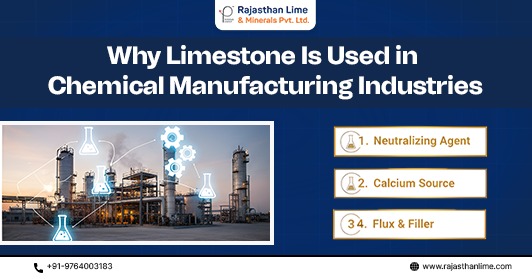
One of the most depended-upon materials in the chemical manufacturing industry is limestone. It is a naturally abundant, cost-effective, and chemically versatile mineral that acts as a raw material, purifier, environmental control agent, and functional additive in chemical manufacturing industries. All of these properties further define its role across different industries. With its abundance in India being in Rajasthan, limestone manufacturers Rajasthan see a huge demand to supply this material across different sectors for varying uses.
What Are the Primary Roles of Limestone in Chemical Manufacturing?
Limestone is used to serve multiple industrial roles due to the ability of calcium carbonate to convert into other materials or react in controlled ways. Each reaction it undergoes or material it turns into is used to fulfill a specific requirement in manufacturing systems. The primary roles of limestone in chemical manufacturing define its use as:
1. Raw Material
As a raw material or a chemical feedstock, limestone provides calcium ions, which you can use for the production of a wide range of inorganic as well as organic compounds. When thermally decomposed or chemically reacted, it becomes the starting material for the manufacturing of lime-based and calcium-based chemicals. Its key uses as a raw material in the chemical manufacturing industry include:
- Production of quicklime and hydrated lime
- Manufacture of calcium salts like calcium chloride and calcium nitrate
- Calcium is used for soda ash and glass production
- Acting as a base material for the production of precipitated calcium carbonate (PCC)
2. Reactive Flux
Limestone’s many qualities include readily reacting with acidic or impurity-forming substances, due to which it is considered a reactive flux. In chemical plants, it is used in the purification of different materials, which directly affects the product quality, catalyst life, and regulatory compliance of the material it is purifying. The common purification roles of limestone that increase its demand from limestone manufacturers Rajasthan include:
- Neutralization of acidic process streams
- Removal of sulfur, phosphorus, and silica impurities
- pH control in chemical reactors and effluent systems
3. Environmental Reagent
Limestone is used to neutralize acidic pollutants and capture harmful emissions spread in the environment. Hence, it is used as an environmental reagent. This ability defines its use in pollution control. With the world’s focus on preventing pollution to the maximum extent and adhering to environmental regulations, the use of limestone as an environmental reagent has expanded significantly. The environmental applications of this natural mineral include:
- Flue gas desulfurization (FGD) in chemical plants
- Neutralization of acidic wastewater
- Treatment of industrial effluents is harmful to the environment
- Stabilization of chemical waste residues
4. Functional Filler
Beyond its reactive properties, limestone is also considered valuable due to its physical properties. As a functional filler, limestone is used to enhance the mechanical strength, stability, and processability of materials without chemically interfering with their chemical formula. Limestone manufacturers Rajasthan supply this mineral to be used as a functional filler for enhancing the quality of:
- Plastics and polymer compounds
- Adhesives and sealants
- Paints, coatings, and surface treatments
- Rubber and elastomer manufacturing
Chemical Derivatives of Limestone
To be used in chemical manufacturing, limestone is transformed into several derivatives, all of which have varying chemical properties. Some of the most common derivatives are:
1. Quicklime
Quicklime, also called calcium oxide (CaO), is produced by limestone undergoing calcination, i.e., being heated in a controlled process. Its high reactivity makes it suitable for rapid chemical transformations. The primary uses of quicklime include:
- pH adjustment in chemical reactors
- Desulfurization and impurity removal
- Being an intermediate feedstock for hydrated lime
- Heat-generating reactions in chemical synthesis
2. Slaked Lime/Hydrated Lime
Lime for copper industry turns out to be an important material in the form of slaked lime or hydrated lime. This derivative is produced by adding water to quicklime, which ensures its low reactivity but strong alkalinity. The key applications of this material include:
- Neutralization of acidic chemicals
- Treatment of water and wastewater treatment
- Used in chemical stabilization processes
- Being an intermediate reagent in specialty chemicals
3. Precipitated Calcium Carbonate (PCC)
Precipitated calcium carbonate is a refined form of calcium carbonate produced through chemical precipitation. It is used in chemical manufacturing when performance consistency is critical and is produced freshly to meet exact formulation needs. Its major uses include the manufacturing of:
- High-performance plastics and polymers
- Pharmaceuticals and food-grade chemicals
- Specialty coatings and inks
- Paper and specialty material applications
4. Sodium Carbonate (Soda Ash)
Limestone is a crucial part of the Solvay process, which is the most widely used industrial method for producing sodium carbonate (soda ash). Although it is a sodium-based compound, limestone remains chemically indispensable to its production cycle. The uses of soda ash supported by limestone include the production of:
- Glass manufacturing chemicals
- Detergents and cleaning agents
- Chemical buffering systems
- Industrial pH regulation
5. Calcium Chloride
After lime is derived from limestone, the lime is used to produce calcium chloride. Its high solubility and hygroscopic nature make it valuable for chemical operations. It is mostly used in the production of:
- Moisture control and drying agents
- Heat transfer fluids
- Chemical process stabilization
- Dust and emission control systems
Conclusion
Limestone tends to be of massive use in chemical manufacturing industries. Whether it is used as a raw material, purifier, environmental reagent, or functional additive, limestone plays an important role in chemical processes across various sectors.
If you are in need of a large quantity of limestone for any purpose, then Rajasthan Lime is here to fulfill it. We at Rajasthan Lime stand as one of the best lime manufacturers in Rajasthan, giving our services to clients across the world from many different industries for the last 40 years. Contact us now to fulfill your demand for limestone and benefit from our top-class quality of limestone as well as quick supply.
FAQs
Q. What are the benefits of using limestone?
There are several benefits of using limestone that are seen in its physical and chemical properties. Some of those benefits are highlighted in the form of its durability and thermal insulation, along with its ability to give rise to derivatives like calcium chloride, soda ash, PCC, quicklime, and hydrated lime.
Q. Which industry uses limestone most?
The cement industry uses limestone the most as a raw material in the production of cement and construction material, and to purify and clean iron blast furnaces.
Q. How does limestone remove impurities?
The impurities that limestone is used against are mostly silicon dioxide (sand). The calcium carbonate in the limestone reacts with the silicon dioxide to form calcium silicate (slag), which can be easily removed.