
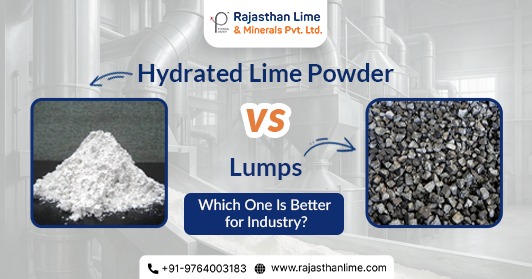
In today’s world, industry professionals have to spend a good amount of time and effort to decide whether hydrated lime powder or lumps are better suited for their respective operations. This is because suppliers emphasize availability and cost of the material, while engineers focus on reactivity, dosing accuracy, and safety. However, the ultimate choice depends on the industry, process design, safety requirements, and handling capabilities, considering all of which is the best way to make an informed choice based on applications, not assumptions.
What Is Hydrated Lime Powder?
Hydrated lime powder, also called calcium hydroxide (Ca(OH)₂), is produced by adding water to quicklime (calcium oxide). This hydration process converts quicklime into a fine, dry, alkaline powder which is suitable for immediate industrial use. The hydrated lime quality standards lead to its use in industries that require precise chemical dosing or fast reactions. The following are the characteristics of hydrated lime powder:
- Fine, dry, free-flowing material with high surface area
- Contains 90–95% calcium hydroxide
- Rapid reactivity when mixed with water or acidic substances
What Are Hydrated Lime Lumps?
Hydrated lime lumps are solid masses of calcium hydroxide that are produced for specific applications or are a result of partial hydration and compaction during manufacturing, handling, or storage. These lumps are mostly used in traditional construction methods, soil stabilization, and specific metallurgical procedures. Its key characteristics are:
- Irregular solid pieces with a lower exposed surface area
- Slower reaction rate
- Requires crushing or slaking before use
- Easier to handle manually
What Is the Difference Between Hydrated Lime Powder and Lumps in Industries?
As for a detailed explanation, the following is the difference between hydrated lime powder and hydrated lime lumps supplied by quick lime manufacturers in India, as seen in their industrial applications, properties, handling, storage, transportation, purity, reactivity, etc.
1. Industrial Applications
When you are choosing between hydrated lime powder and lumps, industrial suitability is among the primary factors you must consider. Hydrated lime powder is made for controlled, continuous, and automated industrial environments while lumps are more suitable for manual applications where precision is less critical. Their applications are:
- Hydrated lime powder: Used in water and wastewater treatment, chemical manufacturing and neutralization processes, precipitated calcium compounds, etc.
- Hydrated lime lumps: Used for traditional plastering, oil stabilization in rural infrastructure, small-scale metallurgical fluxing, and on-site slaking operations
2. Ease of Handling, Storage, and Transportation
The handling and logistics aspects considered for both the materials directly affect the operational safety, labour costs, and material losses. Here, hydrated lime powder is compatible with silos, pneumatic conveying, and sealed packaging, but dust control measures need to be taken to maintain the quality of the material. Meanwhile, lumps generate less airborne dust but they are bulkier and less compatible with automated systems. The following are the handling and logistics considerations of both:
- Hydrated Lime Powder: Easy to automate, requires dust control and PPE, and has a higher risk of moisture absorption, subject to poor storage
- Hydrated Lime Lumps: Lower dust generation during handling, is difficult to convey mechanically, and has greater variability in size and breakage during transport
3. Purity, Reactivity, and Performance
One of the most important technical differences between powder and lumps is their reactivity. This factor is what determines the efficiency of their performance during neutralization, precipitation, or binding reactions. Hydrated lime powder has a higher surface area, due to which it reacts faster and more completely. However, the lumps react slowly and inconsistently.
- Hydrated Lime Powder: Faster chemical reaction due to high surface area and lower material wastage in controlled dosing
- Hydrated Lime Lumps: Slow reaction rates, need additional processing before use, and performance outcomes are not very predictable
4. Environmental and Safety Considerations
Across various industries, considering environmental hazards and safety standards is crucial. Considering both, the two forms of hydrated lime need to be handled carefully, but the risks differ in nature rather than magnitude. The following are the safety and environmental aspects associated:
- Hydrated Lime Powder: It requires dust extraction and respiratory protection and is preferred in regulated industries
- Hydrated Lime Lumps: It has lower airborne dust than powder but high risk during manual handling. It is also less suitable to be used in enclosed or automated industrial environments.
5. Physical and Chemical Composition
Both hydrated lime powder and lumps are calcium hydroxide. However, their physical form creates a difference as it influences how effectively the material is used across industries or purposes. The following are their composition-related differences:
- Hydrated Lime Powder: Have a uniform particle size distribution, higher effective availability of Ca(OH)₂, and quality control and compliance testing can be done easily.
- Hydrated Lime Lumps: Have a non-uniform internal structure and lower effective surface exposure
| Parameter | Hydrated Lime Powder | Hydrated Lime Lumps |
| Physical form | Fine powder | Solid lumps |
| Reactivity | High and fast | Low to moderate |
| Automation suitability | High | Low |
| Dust generation | High | Low |
| Industrial preference | Modern industries | Traditional applications |
Conclusion
In the present-day industries, the hydrated lime powder is chosen over lumps due to its efficiency, consistency, safety, and regulatory compliance. Besides them, the hydrated lime lumps also carry relevance in traditional or small-scale applications. Out of them both, the right choice ultimately depends on the requirement of your industrial process you wish to use the material for, along with handling infrastructure and safety protocols.
If you are looking for a hydrated lime supplier, then Rajasthan Lime is the best for you. We at Rajasthan Lime have an experience of 40 years in providing A-grade quality of hydrated lime with timely and safe delivery, as well as at an appropriate cost. Contact us and benefit from our hydrated lime and our memorable customer service.
FAQs
Q. What is hydrated lime powder used for in construction?
In the construction field, the hydrated lime powder is used for soil stabilization, whitewashing, lime paint, water treatment, etc.
Q. What is the use of hydrated lime in water treatment?
Hydrated lime’s role in water treatment is to adjust the pH level of acidic water by neutralizing acids, along with precipitating various metals into recoverable solids.
Q. Is hydrated lime powder dangerous?
Yes, hydrated lime powder is dangerous to touch without protective gear, as it is a strong base. It is also responsible for causing rapid chemical reactions.