
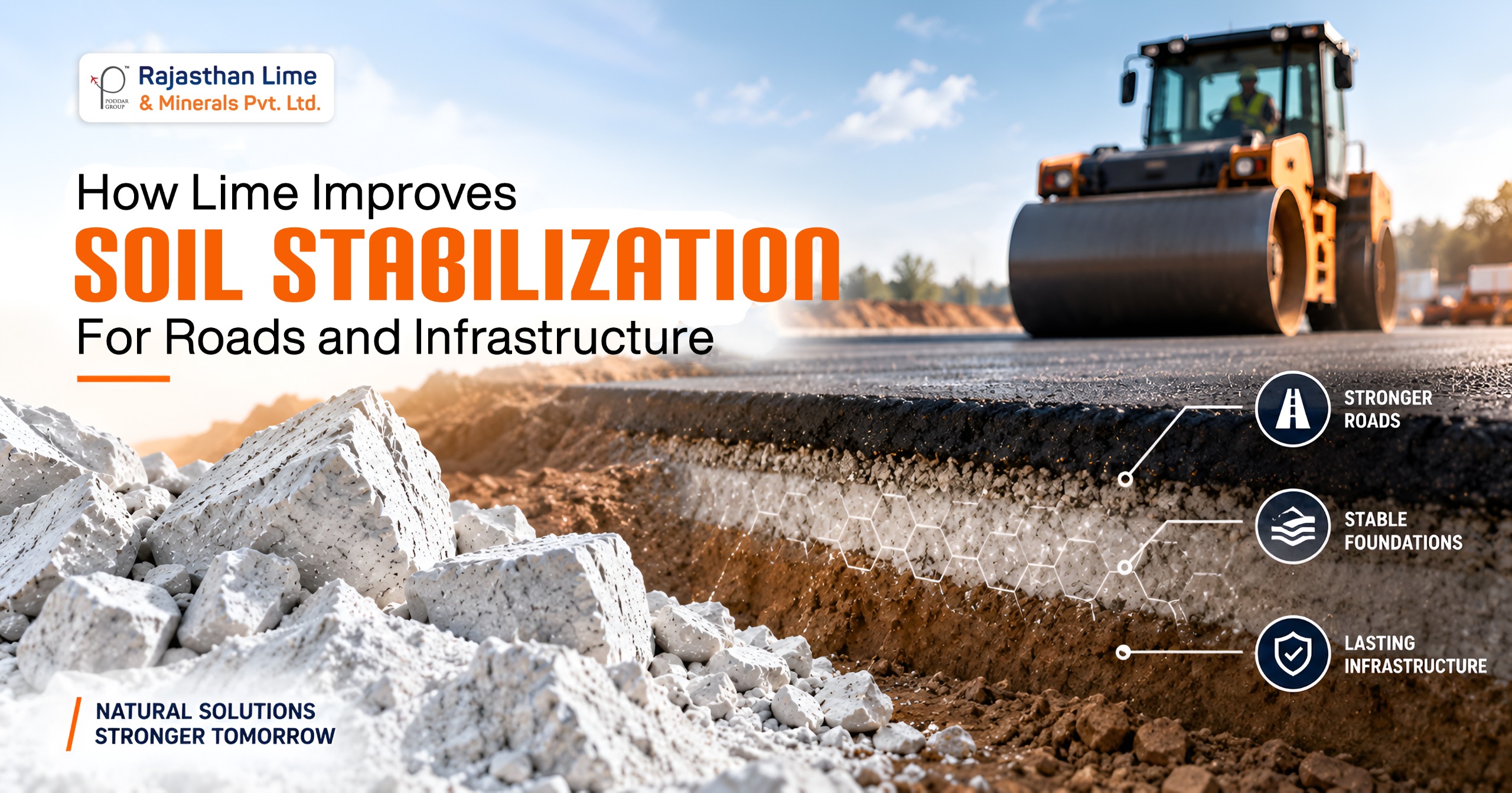
The quality of infrastructure like roads and highways depends greatly on the quality of the soil beneath them. If the soil is weak, highly plastic, too wet, or prone to swelling and shrinking, it can lead to uneven settlement, pavement cracking, and premature deterioration. This is where lime soil stabilization, particularly with the use of quicklime and hydrated lime, comes in need. Depending on soil chemistry, moisture, mineralogy, amount of sulphate, and the performance requirements of the infrastructural project, lime is used as one of the major components in soil stabilization and the overall construction process.
How Is Lime Used in Soil Stabilization?
For soil stabilization, lime is mixed into suitable soil in a controlled quantity, and then incorporated, compacted, and cured to modify the soil’s properties. The following are some points that explain how the best lime for soil stabilization in India is used:
1. Soil Testing and Lime Selection
Understand the soil by testing it for particle-size distribution, moisture content, Atterberg limits, pH, organic matter, and soluble sulphates before lime selection. The amount and type of lime to be used in soil stabilization for roads are determined after laboratory evaluation.
2. Lime Application and Mixing
Lime is distributed over the soil surface and mixed to the required treatment depth. Depending on the project and material, lime is introduced in its dry form or as a slurry. Proper mixing of lime while forming stabilized soil for road construction matters because untreated portions can create weak zones within the layer of the soil.
3. Compaction and Curing
After mixing, the treated soil is brought to the required moisture condition and compacted. Compaction helps achieve the required density and creates a more uniform stabilized layer. Curing is also important in soil stabilization with lime because many reactions that increase the soil strength consume time.
Why Is Lime Used in Soil Stabilization?
Lime for soil stabilization in India is used because it helps in drying, reducing soil plasticity, improving workability, increasing strength, and controlling soil swelling and shrinkage.
1. Reduces Soil Plasticity
High plasticity of soil can change with changes in its moisture content. When it is wet, it may become sticky and difficult to compact. Lime changes the soil-water chemistry through reactions involving calcium ions and clay particles. This process is known as cation exchange and is used to reduce plasticity and cause clay particles to agglomerate.
- Lower plasticity can improve handling and compaction.
- The soil becomes less sticky when wet.
- Shrink-swell behavior can be reduced in suitable soils.
- The treated material can become easier to work with during road construction.
2. Controls Soil Swelling and Shrinkage
Lime can reduce swelling and shrinkage due to water by modifying the clay’s mineral and chemical behavior. Its use results in:
- Reduced expansion during wet conditions.
- Reduced shrinkage during drying.
- Lower risk of differential movement in suitable subgrades.
- Better dimensional stability of the soil.
3. Increases Soil Strength
Strength improvement is one of the major reasons why lime is used in soil stabilization. The use of this material shows the following impacts:
- Bearing capacity increases.
- The stabilized layer can provide improved support for pavement layers.
- Laboratory strength testing helps determine whether the treatment meets project requirements.
What Are the Benefits of Using Lime for Soil Stabilization?
The use of materials like quicklime and hydrated lime in soil stabilization comes with various benefits in the construction of the project and improvements in engineering. The main benefits of lime stabilization of soil include:
- Improved Soil Workability: The use of lime makes wet and highly plastic soil easier to handle, grade, and compact.
- Better Resistance to Shrink-Swell Problems: Lime treatment can reduce the volume-change behavior of soil, helping it remain almost the same with a rise or decline in moisture content.
- Increased Strength and Stiffness: Lime stabilization can improve the strength and stiffness of fine-grained soils, further improving their supporting capacity and better pavement performance.
- Reduced Dependence on Soil Replacement: Soil stabilization through lime is beneficial for improving the properties of soil, reducing dependence on replacing soil in case of unsuitability.
Frequently Asked Questions (FAQs)
Q. What does lime stabilization do to soil?
Lime stabilization helps to make the soil a stronger, more durable, and more workable foundation material.
Q. Which lime is best for soil stabilization?
Quicklime and hydrated lime are considered the best to use for soil stabilization.
Q. How much lime is needed to stabilize soil?
Lime stabilization requires 4% to 8% lime by the dry weight of the soil, depending on the clay content and plasticity index.
Conclusion
Lime treatment for soil is one of the most crucial parts of any infrastructure project. This process is what helps maintain the different properties of the soil and supports projects with reduced plasticity, controlled shrink-swell behavior, improved workability, and better strength development. However, these benefits also depend upon the quality of lime that is being used.
To ensure that you get the best quality of lime for infrastructural use, contact us at Rajasthan Lime, the best provider of top lime for soil stabilization in India.