
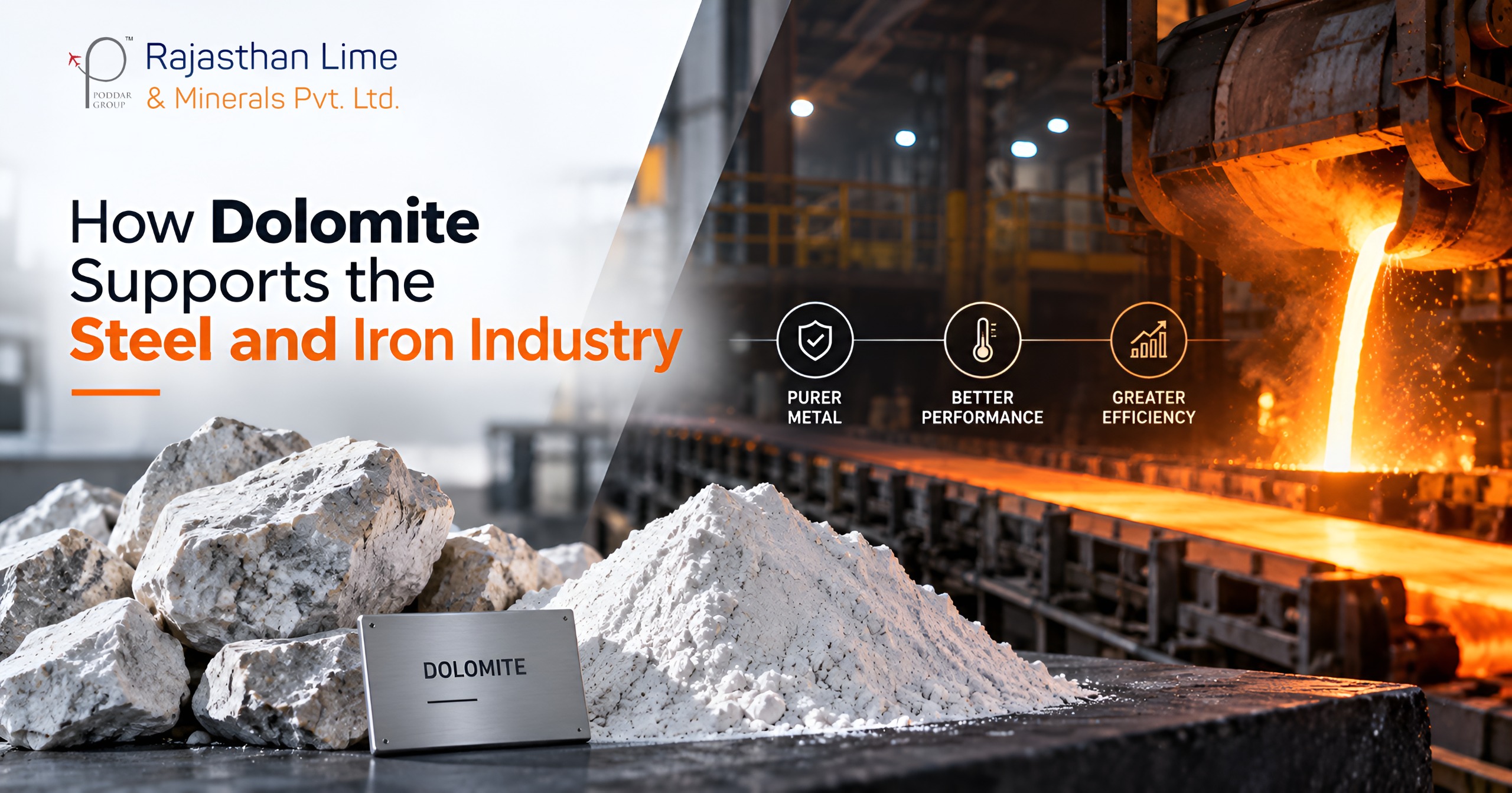
In the various processes that happen in the steel and iron industry, a material that is used with great dependence is dolomite. It supplies calcium oxide (CaO) and magnesium oxide (MgO) after calcination that help control slag chemistry, assist in impurity removal, and contribute to maintaining suitable conditions for refractory protection. Additionally, in blast furnaces, dolomite can be used as a flux. For you to use dolomite in steel industry and iron industry, a few things that you primarily need to know include its overall uses and why this material is depended upon for those uses, which includes its physical and chemical properties.
What Are the Uses of Dolomite in Iron and Steel Industry?
The following are the six major uses or applications of dolomite in steel production and iron production that drive its demand among all suppliers and manufacturers of lime for steel industries:
1. Fluxing Material in Blast Furnace Operations
In the process of blast furnace ironmaking, dolomite is used alongside iron-bearing materials and other fluxes. This makes dolomite useful for:
- Contributing basic oxides to blast furnace slag
- Helping accommodate silica and alumina from the burden of the raw material.
- Adjusting the CaO – MgO balance of the slag
- Supporting controlled slag formation and separation from molten iron
2. Slag Chemistry Control in Steelmaking
One of the most important applications of dolomite for steelmaking is controlling the chemistry of steelmaking slag. Its role includes:
- Supplying CaO and MgO to the slag
- Helping establish the required slag basicity
- Providing a medium for incorporating oxidized impurities
- Supporting controlled slag properties during refining
3. Supporting Impurity Removal
During steelmaking, several undesirable elements or impurities become a part of the process. The efficiency of impurity removal through dolomite lime products in Jodhpur depends on temperature, slag composition, oxygen practice, metal chemistry, etc.
- Oxidized impurities can react with components of the slag
- Basic slag chemistry supports phosphorus removal under suitable conditions
- Slag composition affects the refining reactions
- The required flux addition depends on the chemistry of the individual heat
4. Refractory Applications and Furnace Protection
Dolomite in iron and steel industry drives various refractory applications and uses related to furnace protection, as calcined dolomite can produce a CaO – MgO material with high-temperature stability. Dolomite-related refractory materials can be used in:
- Converter and furnace refractory systems
- Ladle-furnace refractory applications
- The overall environment of the electric arc furnace
- Refractory products based on calcined or processed dolomite
5. Use in Sinter and Fluxed Iron-Bearing Materials
Dolomite is incorporated into agglomerated iron-bearing materials such as sinter and pellets for getting a controlled chemical composition before the material enters the blast furnace. Its use helps in:
- Adjusting the basicity of sinter or pellets
- Introducing MgO into the furnace burden
- Controlling the relationship between basic and acidic oxides
- Producing a more predictable chemical feed for subsequent ironmaking
Why Is Dolomite Used in the Steel and Iron Industry?
Dolomite is one of the most important materials for steel industry and iron industry because it combines two metallurgically useful components, calcium and magnesium. If it is used appropriately after being bought from Jodhpur lime manufacturers, it can contribute to slag formation, slag conditioning, and refractory-related applications across various processes in both industries.
1. Provides Both CaO and MgO
Dolomite is primarily composed of calcium magnesium carbonate. During heating, the carbonates decompose and release carbon dioxide. This process results in the production of calcium- and magnesium-bearing oxides.
- Limestone primarily provides CaO after calcination.
- Dolomite provides both CaO and MgO.
- Calcined dolomite can therefore modify two important components of metallurgical slag.
2. Importance in Steelmaking
MgO from dolomite is particularly important in steelmaking, as steelmaking slags can interact with MgO-containing refractory linings.
- Dolomite for steel production helps maintain an appropriate MgO level in steelmaking slag.
- It can reduce the tendency of slag to dissolve MgO-containing refractory linings.
- It supports better control of slag-refractory interactions.
- It influences slag viscosity, phase formation, and melting behaviour.
3. Valuable for Refractory Performance
Dolomite helps greatly in enhancing the refractory performance because it:.
- Provides raw material for CaO-MgO-based refractory products such as doloma.
- Helps develop refractories capable of withstanding high-temperature conditions.
- Supports resistance to chemical attack from basic steelmaking slags.
- Can help reduce excessive refractory dissolution when slag MgO is properly controlled.
- Requires careful storage because free CaO in calcined dolomitic materials can react with moisture.
What Should You Consider When Selecting Dolomite?
For different processes, different specifications of dolomite should be bought from lime manufacturers in Jodhpur. The following are those specifications that you should check before buying this material:
- CaO and MgO content
- Sulphur and phosphorus impurities
- Loss on ignition (LOI)
- Particle-size distribution
- Reactivity
- Moisture content
- Calcination quality
Conclusion
Dolomite plays a great role in the iron and steel industry by contributing CaO and MgO to high-temperature metallurgical systems, helping control slag chemistry, support impurity removal, and manage interactions between slag and refractory materials. To see success in these applications, it is important that you choose the right quality of dolomite from the best supplier of this material.
If you are currently looking for the best lime supplier in India to purchase dolomite for industrial use, end your search at Rajasthan Lime to get the best quality of dolomite you can find.
Frequently Asked Questions (FAQs)
Q. What are the uses of dolomite in steelmaking?
Dolomite in steelmaking is used as a calcined fluxing agent to remove impurities and as a refractory material to protect the linings of the furnace.
Q. How heat-resistant is dolomite?
Dolomite is naturally a heat-resistant material that can handle standard kitchen temperatures. However, sudden changes in temperature can cause thermal shock.
Q. What is another name for dolomite?
Dolomite is also popularly known as dolostone.