
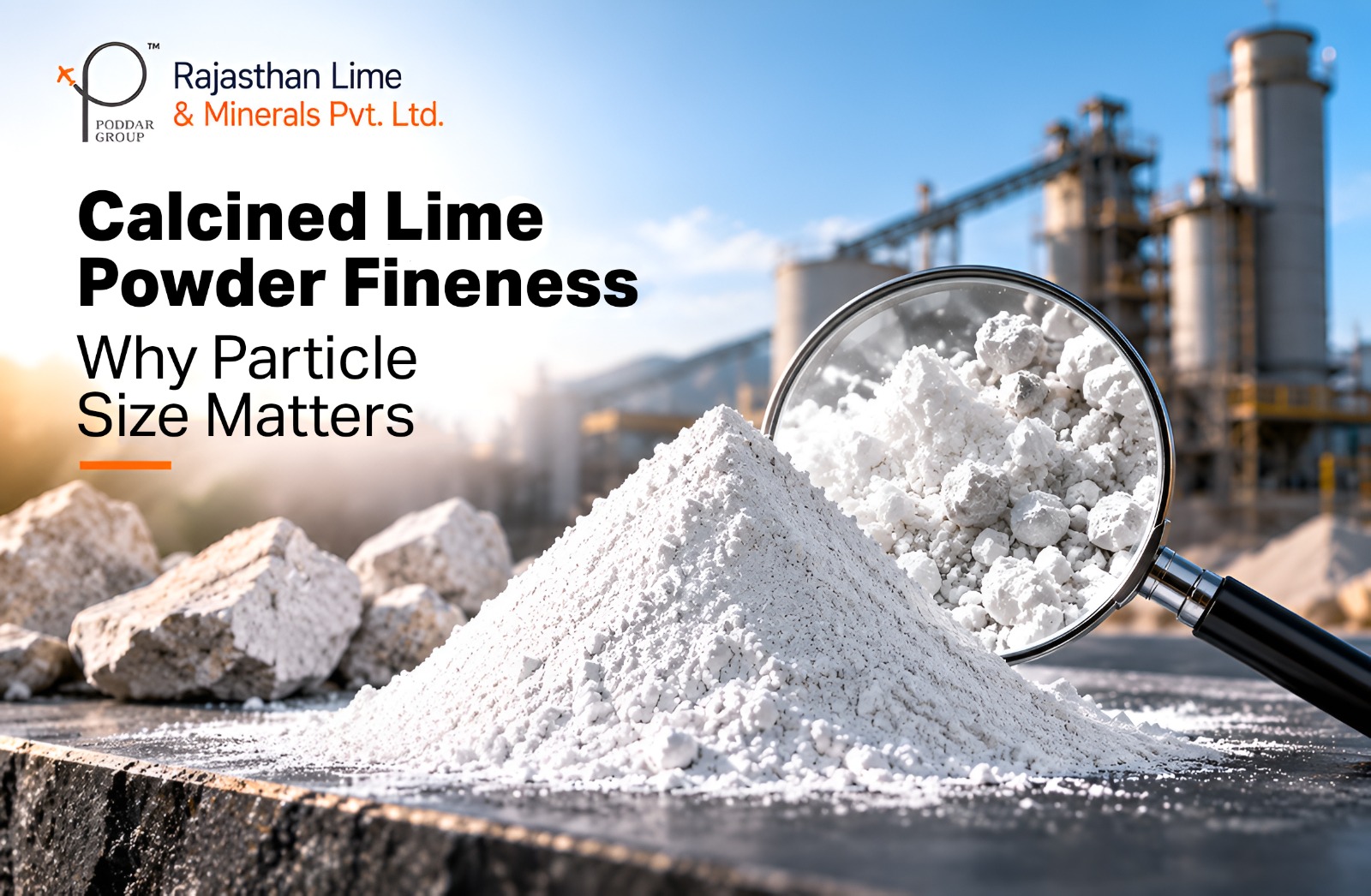
Calcined lime powder is used to drive a number of applications across industries. How quickly the material reacts, how easily it mixes with other ingredients, and how consistently it performs in industrial applications are factors that are influenced by the calcined lime powder fineness. This explains the importance of choosing calcined lime powder with the right particle size, which depends on the intended use, chemical composition, and required performance.
What Are the Different Particle Sizes of Calcined Lime Powder?
One of the best calcined lime powder manufacturers in Jodhpur, from whom you wish to buy this material, provides calcined lime powder with four different particle sizes. For this material, the particle size depends on the crushing, grinding, and classification processes used after calcination. The following are the four types:
1. Coarse Calcined Lime
Coarse calcined lime contains the largest particle size of the powder.
- Available to be used as lumps, granules, or coarsely crushed particles.
- Applications: Industrial processes that require larger pieces or further on-site processing.
2. Medium-Fineness Calcined Lime Powder
Medium-fineness lime is processed to produce smaller particles without very fine grinding.
- Available to be used as ground powder with a moderate particle-size distribution.
- Applications: Selected industrial chemical processes and manufacturing operations, depending on their specifications.
3. Fine Calcined Lime Powder
Fine calcined lime powder offered by Rajasthani lime manufacturers contains smaller particles and provides more exposed surface area.
- Available to be used as a fine ground powder.
- Applications: Processes that require relatively rapid reaction or uniform dispersion.
4. Ultra-Fine Calcined Lime Powder
Ultra-fine lime powder provides the smallest particle size you can find for this material.
- Available to be used as a very fine ground material, sometimes specified by a particle-size distribution rather than only a sieve.
- Applications: Selected specialty formulations and industrial processes requiring fine dispersion.
Why Should You Choose the Right Calcined Lime Powder Particle Size?
The fineness of calcined lime powder bought from the top calcined lime powder manufacturers in India influences the available surface area, reaction behaviour, mixing characteristics, dust generation, and handling requirements. The following explains why you should pick the material with the right particle size for different calcined lime powder applications:
1. Reaction Speed
Smaller particles provide more surface area, allowing a reacting liquid or gas to contact more of the material.
- Fine particles react more rapidly when they get into sufficient contact with the reacting medium.
- Coarser particles of this lime powder may react more slowly due to the reacting medium having less surface area.
2. Mixing and Uniformity
Particle size affects how evenly lime can be distributed throughout a mixture.
- Fine powder disperses more readily in suitable systems.
- Large particles can require additional mixing time or further size reduction.
- A broad particle-size distribution leads to segregation during transport or handling in some systems.
3. Processing Efficiency
The particle size influences the processing efficiency, i.e., how easily lime moves through feeders, enters a reactor, or mixes with other materials while being used.
- A suitable particle size can help maintain a consistent material feed.
- Correct size of particles reduces unnecessary reprocessing of the powder.
- Very fine material may increase dust-control requirements and create handling challenges.
- Coarse material may require additional grinding if the process needs smaller particles.
4. Product Quality
Choosing the calcined lime powder material with a consistent particle size helps you maintain repeatable conditions throughout the process. However, fineness of the powder alone cannot confirm that the calcined lime powder is suitable.
- A consistent size distribution of the material supports repeatable mixing and processing.
- Excessively coarse particles remain incompletely reacted in processes with limited contact time.
- Fine particles improve contact but cannot compensate for unsuitable chemical composition.
- Sampling and testing incoming material helps identify variation between batches.
How to Do a Calcined Lime Powder Fineness Test?
There are two standard procedures used widely to do a calcined lime powder fineness test. These procedures are IS 6932 (Part IV) and ASTM C110, considered the best for analyzing the quality of this material bought from any of the calcined lime powder manufacturers in Rajasthan.
1. IS 6932 (Part IV)
IS 6932 (Part IV) is part of the Indian Standards series covering various methods of test for building lime. This procedure is relevant to assess the lime intended to be used in the construction field.
- Check the applicable standard
- Prepare the sample of the material to be tested.
- Use the prescribed apparatus, which includes the specified sieve sizes, equipment, and test conditions.
- Record the results of the test by documenting the sample mass, material retained or passing through the specified sieve, and any other measurements required.
- Compare with your project requirements.
2. ASTM C110
ASTM C110 includes methods for evaluating the physical properties of the calcined lime powder you need to use. Its fineness-related methods include sieve analysis and air-permeability testing, where applicable.
- Select the relevant method of testing, whether it is sieve analysis or an applicable air-permeability method.
- Prepare a representative sample of the material.
- Conduct the test using the specific equipment, sieve openings, and operating conditions, or the needed air-permeability apparatus.
- Calculate and report the result
- Check its compliance with the relevant product specification or agreed acceptance limits.
Conclusion
Evaluating the complete calcined lime powder quality is important before using it for any industrial purpose. This quality of the material also includes a particular particle size or level of fineness. To get the required quality of this product at the best price, finding the best brand known for lime production in Rajasthan, as well as supply, is important. One such brand is Rajasthan Lime, known for decades for providing the best quality of calcined lime across Rajasthan.
Frequently Asked Questions (FAQs)
Q. Does finer calcined lime powder always perform better?
Fine calcined lime powder does improve the reaction speed, but too much fine calcined lime powder would lead to more dust, handling difficulties, and grinding costs.
Q. What is the ideal fineness of calcined lime powder?
The ideal fineness of calcined lime powder depends on the application it is being used for.
Q. Which standard is used to test calcined lime powder fineness?
ASTM C110 and IS 6932 (Part IV) are two standard procedures used to test the fineness of calcined lime powder.