
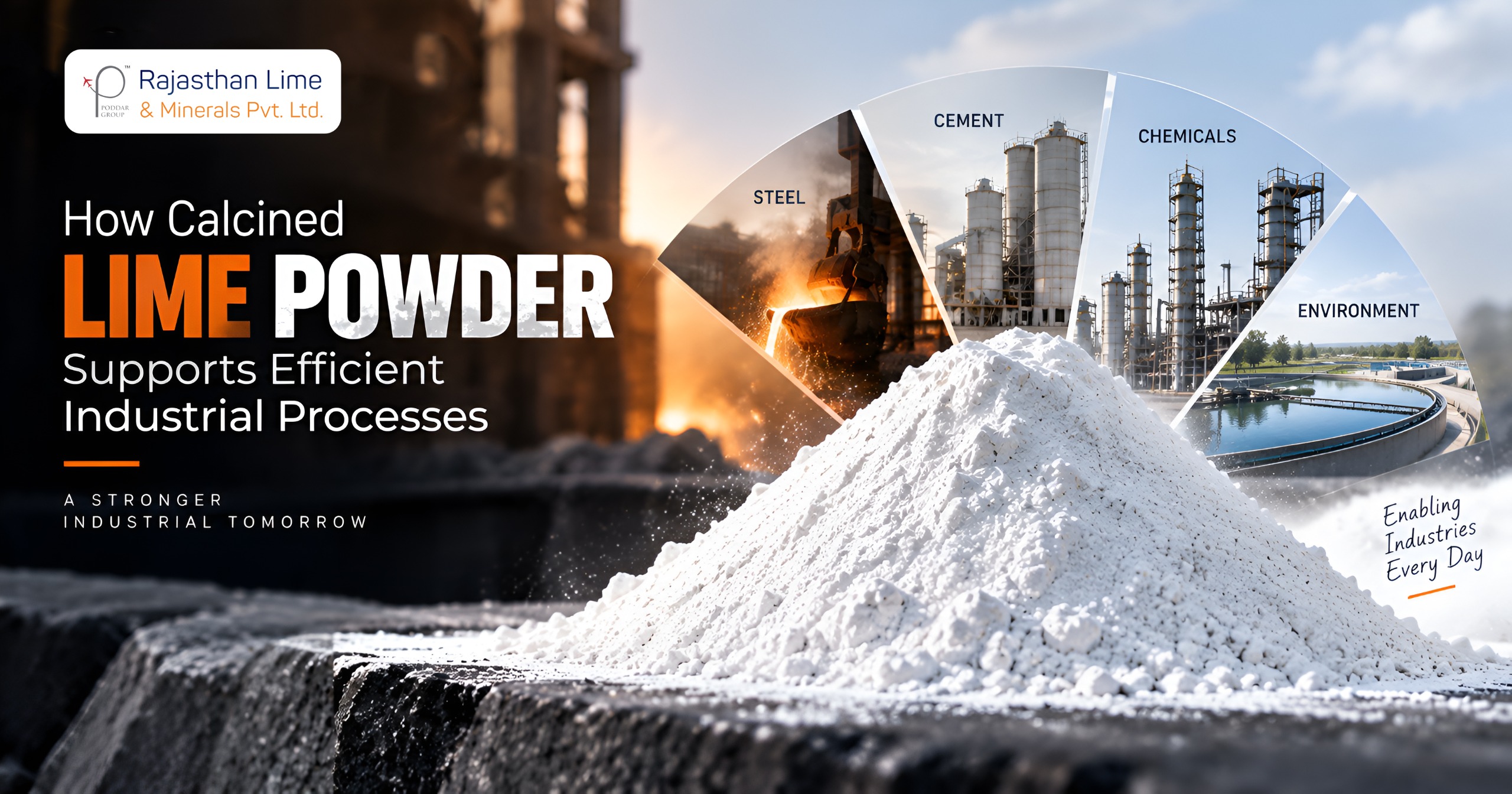
Calcined lime powder, or quicklime, is one of the most important industrial materials in today’s time because it can react with water, acids, and other compounds, making it useful in processes that require chemical control, impurity removal, or material conditioning. It is used across a number of industries like steel, sugar, chemicals, water treatment, construction, and mining, with heavy dependence from users. However, to put this material to its best use, you need to know about the properties that define its use, along with the benefits it provides that make it a material carrying such huge dependence.
What Are the Industrial Calcined Lime Powder Uses?
Calcined lime powder is valued mainly because calcium oxide is chemically reactive and strongly alkaline. Its uses vary across all industries, as this material can act as a flux, neutralizing agent, reactant, conditioning material, or precursor for other lime compounds. The following are some uses of this material bought from calcined lime powder manufacturers in Rajasthan across industries:
1. Steel Manufacturing
Steelmaking is one of the major industrial applications of calcined lime, where its uses are as follows:
- It helps form a basic slag during steelmaking.
- It reacts with acidic impurities such as silica.
- It supports separation of impurities from molten metal.
2. Sugar Processing
Lime has a long-established role in sugar manufacturing, particularly in the clarification of sugarcane juice. In sugar processing, the calcined lime powder uses are as follows:
- Assists in precipitating and separating impurities.
- Supports downstream filtration and processing.
- Requires lime with suitable chemical characteristics for the specific process.
3. Water and Wastewater Treatment
Calcined lime can be used directly in water treatment and can also serve as a raw material for producing calcium hydroxide, commonly called hydrated or slaked lime.
- It supports water softening by participating in precipitation reactions.
- It is used for sludge treatment.
- It can be converted into calcium hydroxide for further treatment applications.
- It helps in adjusting chemical conditions in selected treatment processes.
4. Chemical, Mining and Construction Processes
The uses of calcined lime are also visible in the chemical and construction sectors as well, which are as follows:
- It acts as a chemical reagent in selected manufacturing processes.
- It supports mineral and ore processing.
- It can be used for soil stabilization.
- It serves as a feedstock for producing other calcium-based chemicals.
Which Properties Define Calcined Lime Powder Applications?
There are a number of calcined lime powder benefits and applications that are a result of the physical and chemical properties of this material. The following are the properties that influence the heavy dependence on this material after being bought from reliable calcined lime suppliers Rajasthan:
1. Calcium Oxide (CaO) Content
The available CaO content in calcined lime powder is important to consider as it is the principal reactive component of quicklime. For every use across industries, the required CaO level varies.
- It indicates the amount of useful calcium oxide available.
- It influences chemical performance.
- It should be evaluated alongside impurities.
- It needs to meet the specification required by the end application.
2. Reactivity
The reactivity of this material describes how readily lime responds under very specific conditions of a process. It is influenced by factors such as calcination conditions, porosity, particle size and the original limestone. Meanwhile, the reactivity property affects calcined lime powder applications in the following ways:
- Reaction speed
- Hydration behaviour
- Process efficiency and dosing
3. Particle Size and Fineness
Particle size influences how quickly a solid material interacts with other substances. While optimum size depends on the industrial process and the equipment used in the process, most of the users pick fine particles as they provide greater surface area. The particle size and fineness of calcined lime powder:
- Influences available surface area.
- Can affect reaction rate.
- Needs to match the feeding and handling system.
- Should be specified according to the industrial process.
4. Impurities and Moisture
Impurities can influence the suitability of lime for particular industrial applications. Materials such as silica, alumina, iron compounds, magnesium oxide and other constituents may need to remain within application-specific limits.
- Excess moisture can initiate unwanted hydration.
- The presence of impurities will negatively affect process chemistry.
- Storage conditions should protect the material from moisture.
- Test certificates should be reviewed against the required application specification.
How Should Industries Select and Handle Calcined Lime Powder?
While buying calcined lime powder from calcined lime suppliers Rajasthan, many industrial buyers make mistakes in choosing the material with the required CaO content, reactivity, particle size, and moisture level. Hence, before buying calcined lime, here is what you need to check:
- Define the intended industrial application first.
- Check all the chemical and physical specifications against process requirements.
- Ask for relevant test reports or certificates of analysis for this material.
- Store quicklime in dry and protected conditions.
- Prevent uncontrolled contact with water during storage and handling.
Conclusion
Calcined lime powder supports industrial efficiency through its roles as a flux, alkaline reagent, impurity-control material and chemical precursor. While its benefits across industries are significant, these can be seen only when you are using the right quality of calcined lime from one of the most trusted lime suppliers India.
Contact Rajasthan Lime to fulfill your need for calcined lime powder with the best quality of the material to enhance your process.
Frequently Asked Questions (FAQs)
Q. What is calcined lime used for?
Calcined lime powder is used as a flux agent in steel manufacturing, for pH adjustment in wastewater treatment, in the production of mortars, plasters, and soil stabilization, as well as paper manufacturing, sugar processing, and pollution control.
Q. How to turn limestone into quicklime?
Limestone is turned into quicklime through the process of thermal decomposition or calcination.