
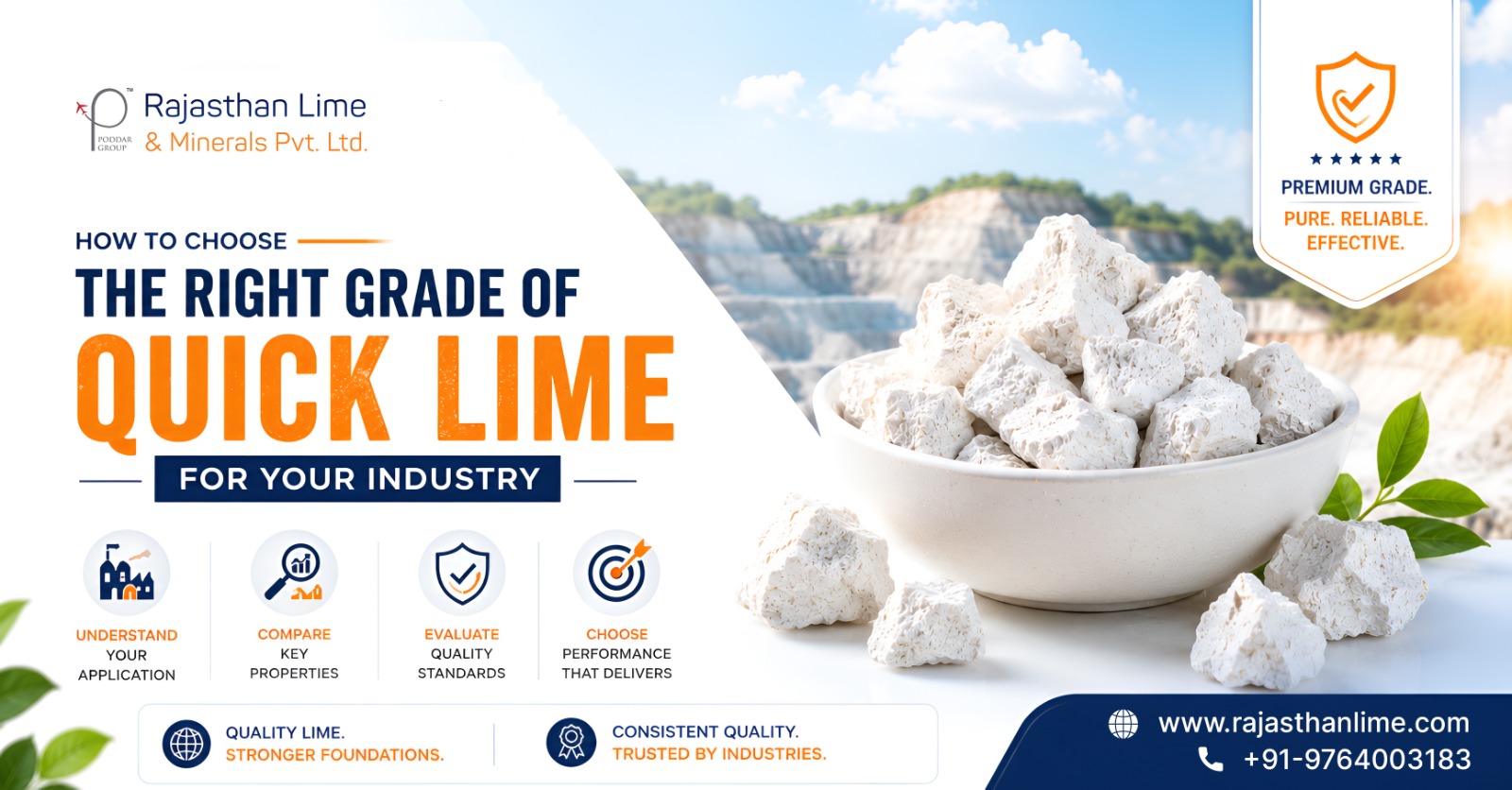
Among all the industries across India, one of the most widely used materials for different purposes is quick lime. It is used across a variety of sectors such as steel, construction, water treatment, sugar manufacturing, chemicals, mining, paper, and agriculture. As its use across industries varies, so do the types that are used across those industries. For example, the best quick lime for the steel industry varies in its type from other sectors. The classification of these types is done on the basis of purity, also called grades. Additionally, the best type for one’s use is chosen due to the chemical composition, reactivity, impurity limits, and physical characteristics of quick lime.
How Many Types of Quick Lime Are There Based on Purity?
The purity of quick lime directly influences its reactivity, strength, and suitability for industrial applications. On the basis of purity, there are three types of quick lime that you can find: high-calcium quick lime, dolomitic quick lime, and hydraulic quick lime.
1. High-Calcium Quick Lime
High calcium quick lime, just like its name explains, contains high levels of calcium oxide with low magnesium content. It is one of the most widely used forms of quick lime across industries requiring efficient chemical reactions. The common industrial applications of this material include steel manufacturing, water and wastewater treatment, sugar refining, chemical production, and glass manufacturing. Meanwhile, the advantages of using this material include:
- High reactivity
- Excellent neutralization capacity
- Lower impurity levels
- Consistent product quality
- Suitable for precision industrial processes
2. Dolomitic Quick Lime
Dolomitic quicklime is manufactured from dolomite, a compound containing both calcium carbonate and magnesium carbonate. This material is suitable for industries requiring slower hydration or enhanced refractory performance. It is used in refractory manufacturing, the agriculture sector, soil stabilization, glass production, and environmental applications. The following are the advantages of using dolomitic quick lime.
- Higher volume of magnesium
- Better refractory performance
- Improved resistance to thermal stress
- Useful in magnesium-demanding industrial processes
3. Hydraulic Quick Lime
Quick lime is essential in construction, and in this sector, it is used in the form of hydraulic quick lime. Some common applications of hydraulic quick lime include building restoration, masonry work, lime mortars, and construction. The advantages of using it include:
- Sets under moist conditions
- Better flexibility than cement in heritage structures
- Improved breathability
- Reduced cracking in certain masonry applications
How to Choose the Right Type of Quick Lime?
To choose the right type of quick lime that you can use in your industrial applications, you should know several things, such as the specific industrial process, desired chemical performance, equipment compatibility, quality requirements, and choosing one of the best quick lime manufacturers in Rajasthan to fulfill your demand.
1. Understand Your Industry Requirements
Different industries and applications require different chemical properties, influencing the material to be used.
- Steel manufacturing needs high-calcium quicklime with high reactivity.
- Soil stabilization may perform well with dolomitic quicklime.
- Heritage restoration generally benefits from hydraulic quicklime.
2. Check chemical composition
The chemical composition directly influences industrial performance. Hence, you should request a laboratory analysis of the compound you are buying before placing your order. Below are some components you need to check the volume of.
- Calcium oxide (CaO)
- Magnesium oxide (MgO)
- Silica (SiO₂)
- Alumina (Al₂O₃)
- Iron oxide (Fe₂O₃)
- Loss on ignition (LOI)
3. Evaluate Reactivity
Highly reactive quick lime hydrates rapidly and is preferred for several industrial chemical processes. However, some applications perform better with slower-reacting material. Hence, you should always know the reactivity requirements.
4. Review Particle Size
Use of quick lime depends on particle sizes that differ in the following forms:
- Lumps
- Pebbles
- Granules
- Powder
- Fine particles
5. Ensure Overall Quality
Choose a manufacturer who can provide:
- Quality certificates
- Batch testing reports
- Technical specifications
Why Does Quick Lime Quality Matter?
The quality of quick lime has a direct impact on operational efficiency, product consistency, equipment performance, and overall production cost. Hence, choosing the right type of quick lime of the required quality is very crucial.
- Improved production efficiency
- Better product quality
- Lower material wastage
- Reduced maintenance costs
- Greater process consistency
- Compliance with customer and industry specifications
Conclusion
Choosing the right type of quick lime involves not just comparing the prices or purity levels of material but also understanding your industry’s technical requirements, evaluating chemical composition and reactivity, assessing supplier quality practices, and matching the product to the intended application.
To ensure that the quick lime you get is of the best quality, choose Rajasthan Lime as your supplier.
Frequently Asked Questions (FAQs)
Q. What is the difference between high calcium lime and dolomitic lime?
High calcium lime mainly consists of calcium carbonate, while dolomitic lime is a combination of calcium and magnesium carbonates.
Q. What is another name for quick lime?
Another name for quick lime is calcium oxide.
Q. What is quick lime used in the manufacturing of?
Quick lime is used in the manufacturing of steel, cement, paper, chemicals, and glass.