
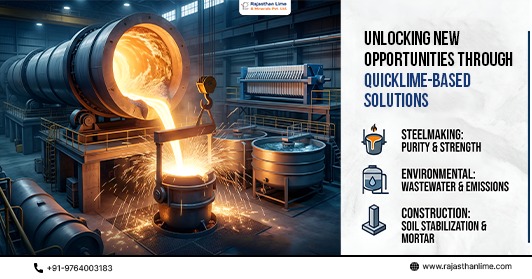
Many industries and important applications and processes across those industries run with the help of limestone and its products, like quicklime. In today’s time, the quicklime-based solutions are used across industries that range from infrastructure and steel production to environmental protection and agriculture. While a wide variety of materials can be used across them all, focusing on sustainability, resource efficiency, and industrial optimization makes you prioritize quicklime the most. This is why it has been used for a long time, even with advancements in material science, process engineering, and environmental regulations.
What is Quicklime?
Quicklime is a highly reactive alkaline material composed of calcium oxide (CaO). This material is produced by heating limestone at high temperatures. Its wide use lies across industrial, environmental, and construction applications due to its chemical reactivity and binding capabilities.
What are the Properties of Quicklime?
There are several physical and chemical properties of quicklime that make it valuable, such as its strong alkalinity, chemical reactivity, and thermal characteristics. When you buy quick lime from quick lime manufacturers in India, the following are its properties and their effects you must know about in detail:
1. High Alkalinity
Quicklime has a very high pH. When reacted with water, it forms calcium hydroxide. This makes it effective for neutralizing acids and treating acidic waste streams. The many applications of quicklime that are a result of its high alkalinity include:
- Its use in wastewater neutralization
- Used in controlling acidic soil conditions
- Stabilizing industrial effluents
- Assisting in pH correction processes
2. Exothermic Reaction with Water
When quicklime reacts with water to undergo hydration or slaking, it releases heat, which makes this process an exothermic reaction. The applications arising due to such reactivity of the material include:
- Drying sludge and waste
- Soil stabilization in cold climates
- Controlled reaction in industrial mixing
- Safety considerations during storage and handling
3. Strong Binding and Stabilizing Capability
Quicklime reacts with silicates and aluminates in soil or several materials to improve the structural strength and durability of those materials. It is used to:
- Improve load-bearing capacity
- Reduce plasticity in clay soils
- Enhance long-term durability of treated surfaces
- Minimize shrink-swell behavior in expansive soils
4. Environmental Reactivity
Quicklime binds impurities such as sulfur and phosphorus during industrial processes. This property supports emission reduction and environmental compliance. Further, this property of quicklime helps in:
- Sulfur removal in flue gas treatment
- Heavy metal stabilization
- Sludge conditioning
- Industrial waste solidification
Applications of Quicklime-Based Solutions
As you already know, many forms of lime, like quicklime and hydrated lime powder, are used across different industries for the efficiency they bring to several applications. In the case of quicklime, its versatility allows it to serve multiple industries simultaneously, showing its considerable industrial value.
Construction Industry
In the construction industry, quicklime is used in a huge volume to enhance soil strength, improve durability, and reduce any major construction risks. This is because construction professionals often face challenges like weak subgrades, high moisture content, or clay-heavy soils. Quicklime’s common construction applications:
- Soil stabilization in roadways and highways
- Subgrade improvement in airports and railways
- Moisture control on wet construction sites
- Foundation support for large infrastructure projects
Steel Industry
Quicklime is an essential part of steel manufacturing as it is used as a fluxing agent and removes impurities such as silica, phosphorus, and sulfur during the smelting process. Its key roles in steelmaking include:
- Formation of slag to remove impurities
- Sulfur control in molten iron
- Improved furnace efficiency
- Enhanced final steel quality
Environmental Protection
Some of the many critical roles of quicklime lie in pollution control and environmental remediation. As regulatory requirements must be followed strictly globally, demand for reliable neutralizing agents has grown. The material is used for:
- Neutralizing acidic discharge in wastewater treatment
- Reducing sulfur dioxide emissions during flue gas desulfurization
- Pathogen reduction and drying during sludge treatment
Emerging Sustainable and Circular Applications
Sustainability is central to industrial planning, and in sustainable and circular applications, quicklime-based solutions are being integrated massively. The innovative developments include:
- Carbon capture processes involving calcium looping
- Industrial waste recycling
- Energy-efficient kiln technologies
- Reduced-emission lime production methods
Conclusion
Quicklime-based solutions continue to impact industries positively in the present with all the new industrial, environmental, and agricultural opportunities that arise. From steel refining and infrastructure development to wastewater treatment and soil improvement, quicklime remains an essential and cost-effective material to be used in modern industries.
To fulfill your need for the best quality of quicklime at the most affordable price, contact Rajasthan Lime, the best lime manufacturers in India. Over the decades of our service, we have satisfied thousands of customers, and you can be the next.
FAQs
Q. What is the difference between quicklime and hydrated lime?
Quicklime is calcium oxide, while hydrated lime is calcium hydroxide, both of them differing in their physical and chemical properties, like their composition, look, colour, etc.
Q. What is another name for quicklime?
Quicklime is also called calcium oxide (CaO) or burnt lime.
Q. Why do farmers use Quicklime in their fields?
Quicklime is used by farmers in their fields to neutralize the acidic or basic nature of the soil for all the plants to grow properly.